
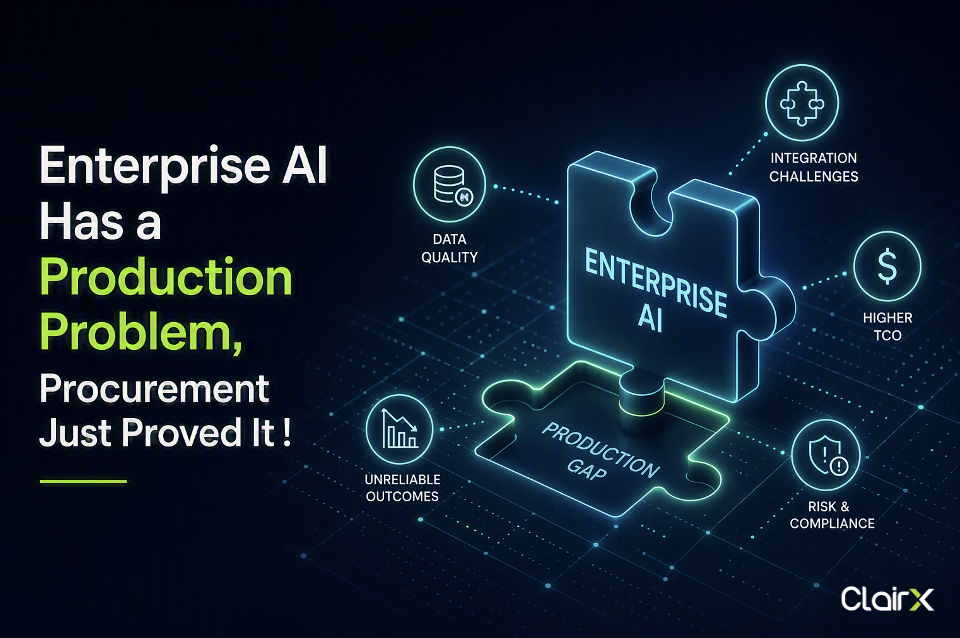
Why a single procurement tender says more about the state of enterprise AI than any trend report — and the operating-model gap it exposes.
At ClairX, we analyse dozens of AI and automation procurement notices every quarter. It's a habit most people in our line of work would call niche, if not slightly odd. But every so often, one lands on my desk that says more about where enterprise AI is actually heading than any glossy AI trend report or social media carousel ever could.
Recently, it was a tender from a large, FCA-regulated institutional investor — a public body responsible for tens of billions of pounds of pension assets — seeking an AI and Automation Implementation Partner. On the surface, a fairly standard public sector notice: a regulated institution, already holding a defined AI strategy, now looking for a partner to help it act on it.
But read between the lines, and it's really a mirror held up to the entire enterprise AI market.
“The prototype era is over. It's just taken procurement this long to say so in writing.”
And what it reflects back is exactly what I've been banging on about to boards, CIOs and public sector leaders for the best part of two years.
Enterprise AI Has Moved Beyond Pilots
Scroll past the mandatory certifications and insurance thresholds that regulated procurements always carry, and look at what's actually being asked for. Not a proof of concept. Not a pilot. Not a flashy demo for a steering committee. The shape of the requirement is consistent across almost every serious enterprise and public sector AI tender I now see:
- Use case assessment and a phased implementation roadmap
- Design, build, testing and deployment to production-ready standard
- Integration with live, mission-critical systems already embedded in the organisation
- AI governance built for a regulated, scrutinised environment
- Change management and staff capability building
- Ongoing post-implementation support, optimisation and performance reporting
- Full technical documentation, runbooks and governance artefacts
That last cluster is the one most vendors skip past. Everyone wants to talk about the build. Almost nobody wants to talk about the Tuesday-afternoon-six-months-later reality of who monitors model drift, who retrains on new data, who owns the runbook when a regulator or auditor asks how a decision was made.
That's not a technology gap. It's an operating model gap — and it's the single biggest reason enterprise AI initiatives stall after the demo.
The Challenge of Scaling AI in Production
Here's the uncomfortable truth I share with every organisation we work with: building an AI proof of concept has never been easier. Off-the-shelf models, no-code agent builders, a weekend and a decent prompt will get you a plausible-looking demo. That's precisely why so many boards and public sector leadership teams are frustrated — they've seen dozens of demos and precious few systems actually running in production, generating measurable value, six months later.
What separates a demo from a genuine capability is the same thing that separates a workshop from a factory: repeatability, governance, and the operational muscle to keep producing value long after the ribbon-cutting.
I call this the AI factory model — not a single project, but a standing capability inside your organisation that can continuously identify, design, build, deploy, govern and improve AI and automation use cases across the enterprise. Not one model in production. A pipeline of them, arriving safely, monitored constantly, and improving quarter on quarter.
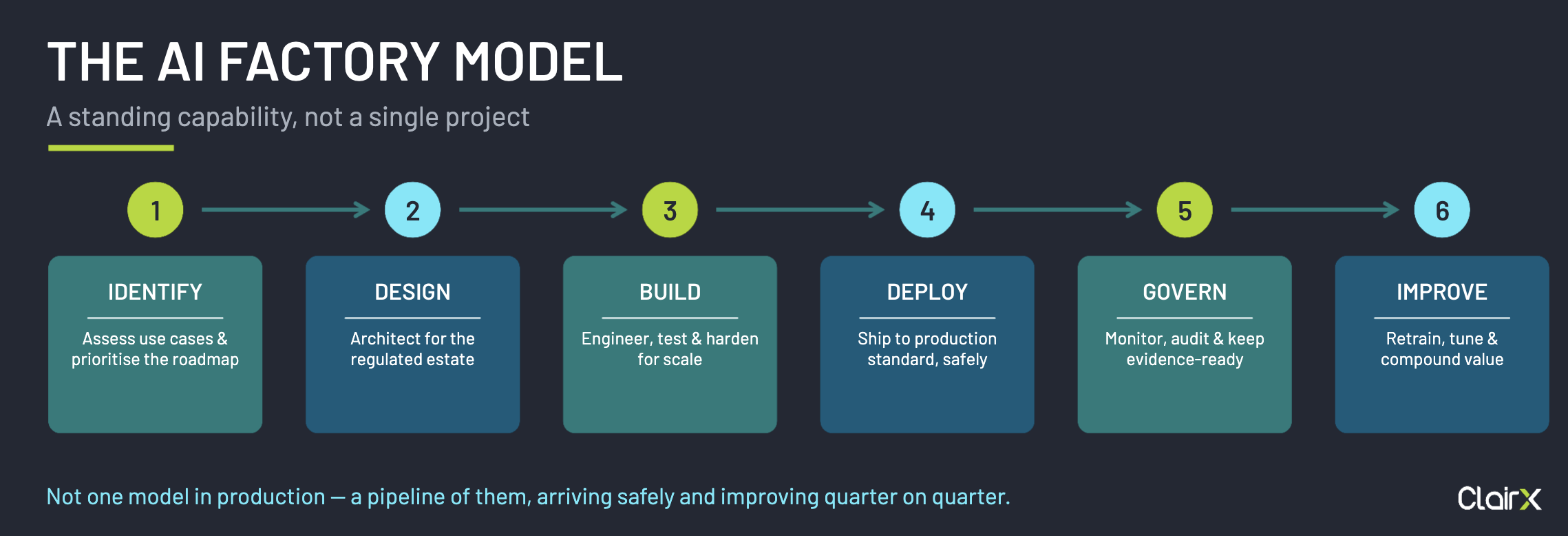
The AI Factory: a standing operating model, not a one-off project.
Increasingly, this is precisely what regulated buyers are procuring — whether it's a pension pool, a local authority, a regulator, or a financial services firm: not a project, but an operating partner for an AI factory that will run inside a complex, multi-system, compliance-heavy environment for years, not weeks.
Why sector fluency and regulatory fluency both matter
The other pattern worth dwelling on is how mandatory these tenders now make sector experience. Buyers are no longer satisfied with generic AI credentials — a chatbot built for a retailer doesn't evidence the ability to work inside an FCA-regulated, audit-heavy, multi-system estate. Increasingly, procurement gateways demand direct, evidenced, referenceable delivery inside the specific regulatory and operational context the buyer sits in, assessed before anything else in the submission is even considered.
That is the market maturing in real time. Regulated buyers of enterprise AI want partners who understand supervisory expectations around model risk and algorithmic systems, who can build for explainability and auditability from day one, and who know their way around the specific systems, workflows and constraints of the sector — not AI expertise in the abstract.
It's a useful discipline to sit with: the unglamorous 80% of enterprise AI is rarely the model itself. It's the governance frameworks, the integration with legacy and cloud estates side by side, the change management that actually lands with the people using the system, and the ongoing operate-and-enhance discipline that keeps an AI factory running safely long after go-live.
A Board-Level Test for AI Readiness
If you're an enterprise, GovTech or RegTech leader reading a signal like this, it should prompt a few honest questions:
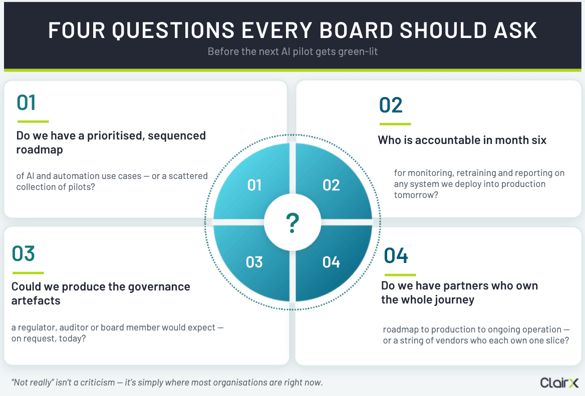
If the honest answer to any of those is “not really,” that's not a criticism — it's simply where most organisations are right now. The gap between AI ambition and AI operating capability is the defining challenge of this phase of enterprise adoption.
The Next Phase of Enterprise AI
The organisations getting this right aren't necessarily the ones with the flashiest AI use cases. They're the ones that have quietly reframed the question.
Not “what can AI do for us,” but “what does it take to run AI safely, continuously, and at scale — inside an organisation that has to answer to a regulator, an auditor, or an electorate.”
That reframing shows up in three places, consistently: how fast good ideas move from concept to production, how much of the organisation's day-to-day workload it genuinely lifts rather than just augments, and whether the people inside the organisation come out the other side more capable, or simply more dependent on whoever built the thing.
Those three markers — pace, efficiency, and internal capability — are, in my view, the real scorecard for enterprise AI maturity. Far more so than the number of pilots in flight or the size of the model in production.

