


AI is moving from experimentation into the core of business operations. Generative AI is already changing how teams create, analyse, automate, and support decisions. Agentic AI goes a step further: it can plan, call tools, trigger workflows, and act across systems with increasing autonomy.
That shift creates a practical leadership challenge: moving quickly with AI while keeping control over data, decisions, security, accountability, and customer trust.
In practice, AI governance works best when it is built into the way AI is designed, deployed, and monitored. It should not sit on a shelf as a policy document. It should operate like infrastructure: always present, consistently applied, and easy for teams to use.
Regulators are reaching the same conclusion. In April 2026, the Federal Reserve, OCC, and FDIC updated US model risk guidance for the first time in fifteen years. Although the guidance does not directly cover generative or agentic AI, it makes one point clear: organizations still need appropriate governance and controls for emerging AI systems, even where the rulebook is still evolving.
Governance is Guardrails, Not Roadblocks
One mistake organizations make is treating governance as an approval layer added late in the process. Effective AI governance is more useful when it is designed into delivery from the start, with clear boundaries, named owners, and practical review points that help teams move without taking unmanaged risks.
With clear ownership and oversight, teams do not need to reopen the same questions on every project: who approves the use case, what data the system can access, which tools it can call, how output quality is checked, and what happens if something goes wrong.
McKinsey’s 2026 State of AI Trust survey found that responsible AI practices are becoming foundational to realizing value from AI investments. The practical point is clear: trust is a requirement for scaling AI beyond pilots and isolated use cases.
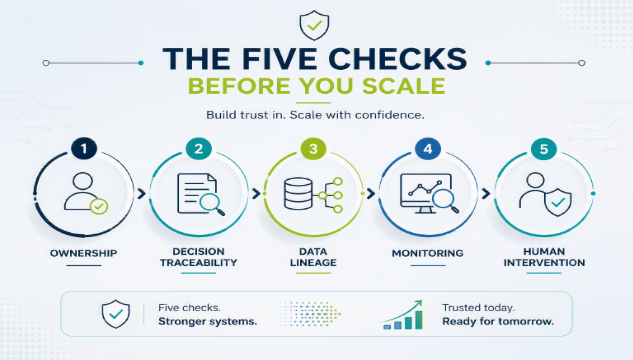
The Five Checks Before You Scale
For any organization moving AI from pilot to production, five checks should be in place before wider rollout.
- Ownership — Is there a named person accountable for the model, agent, workflow, and downstream system behaviour in production?
- Decision traceability — Can the team reconstruct the prompt, model version, tool call, retrieved data, approval path, and output that led to a decision?
- Data lineage — Is it clear what data trained the system, what data it retrieves at runtime, where sensitive data is redacted, and which datasets are approved for use?
- Monitoring — Are drift, latency, hallucination risk, failed tool calls, policy violations, unusual behaviour, and user feedback visible after launch?
- Human intervention — Is there a person with the context and authority to pause, override, roll back, or investigate the system when thresholds are breached?
These checks do not need to be heavy. They need to be proportionate. A low-risk internal productivity tool does not need the same scrutiny as an AI system supporting customer decisions, regulated processes, clinical workflows, credit assessment, fraud detection, or autonomous action.
A useful starting point is to classify use cases by risk, keep a live registry of deployed models and agents, and build logging, lineage, access controls, evaluation metrics, and escalation routes into the architecture from the beginning. This keeps governance close to delivery, where it is most effective.
What we have seen in large-scale AI adoption is that governance works best when it becomes part of the platform, not a separate process around it.
Not All AI Systems Need the Same Controls
Most organisations are not running one kind of AI. They are running a portfolio: predictive models that score, forecast, or classify; generative systems that draft, summarise, and answer; and, increasingly, agentic systems that plan and act. The five checks apply across all three, but the weight of each check shifts as you move along that spectrum, and understanding where a system sits is what makes governance proportionate rather than uniform.
The control burden rises with the system. For a predictive model, the output is a single value produced from a single input, so governance concentrates on training data, validation, fairness testing, and drift once the model is live. These are well-established disciplines with decades of practice behind them. For a generative system, the output is composed rather than selected, so the emphasis moves to grounding, output quality, review paths, and what the system is permitted to say on the organisation’s behalf. For an agentic system, the picture changes again: it runs a repeating loop of perception, reasoning, action, and observation, and each step is a distinct control point. Perception is where you control what data goes in and what gets masked first. Reasoning is where you need traceability. Action is where permissions, approvals, and rate limits belong. Observation is where monitoring and quality checks attach. A system that logs only the final output has no view of the steps that produced it.
Where the older playbook stops working. This is the point at which established model risk practice runs out. A predictive model produces an output and stops. A system that can act repeatedly needs explicit rules about when to stop acting, because left unbounded it may retry a failing call indefinitely, consume budget, or drift further from the original task with each cycle. Three controls do most of the work: stop conditions that define what completion looks like and cap the number of steps or the total spend; retry limits that distinguish a transient failure worth reattempting from a genuine one that should escalate; and hand-off rules that route the task to a human when confidence drops, a threshold is crossed, or the system moves outside its approved scope. These are the AI equivalent of timeouts and circuit breakers, and they belong in the design rather than in the post-incident review.
- Stop conditions define completion and cap steps or spend.
- Retry limits separate temporary failures from issues that need escalation.
- Hand-off rules route work to a human when confidence drops, thresholds are crossed, or scope is exceeded.
Access, Cost, and Choosing the Right Approach
Least privilege and context isolation. Every AI system should hold the narrowest set of data and system permissions its task requires, and nothing more. This principle is familiar from conventional security practice, but AI stretches it in two ways. First, generative and agentic systems are often given broad access precisely because their tasks are open-ended, which quietly inverts the default. Second, where an orchestrator delegates work to specialised sub-agents, the number of things that can act on your systems multiplies. In that pattern, each sub-agent should hold an explicitly defined set of permitted actions, and should operate in its own context, receiving only the information deliberately handed to it. Nothing should flow from the orchestrator or between sub-agents by default. This limits the blast radius when something behaves unexpectedly, keeps sensitive data from spreading further than intended, and makes it far easier to reconstruct what acted, and on whose authority.
Token economics: cost is a governance signal. There is a commercial dimension that leadership teams often meet late. Unlike a trained predictive model, where most of the cost is incurred once, generative and agentic systems consume tokens on every call, and cost scales with usage rather than with development. An agentic system compounds this further: every step of the loop consumes tokens, and every additional sub-agent running in parallel, each with its own context and reasoning, multiplies that consumption. Cost is therefore not a finance-only concern; it is a design constraint and a governance signal. Budget caps per task, visibility of spend by use case, and alerts on unusual consumption belong in the same control layer as logging and access management, not least because a sudden cost spike is often the first observable symptom of a system stuck in a loop.
Match the approach to the problem. The most effective discipline is also the least discussed: choosing the simplest approach that solves the problem. A well-specified rule or a conventional predictive model is frequently cheaper, faster, more accurate, and far easier to explain than a generative one. Where a generative system is genuinely needed, a single well-scoped system usually beats a network of agents.
Where multi-agent designs do earn their cost is breadth-first work: tasks that split into genuinely independent lines of enquiry running in parallel, such as researching a large set of separate sources, evaluating many candidates against the same criteria, or scanning multiple systems at once. Each part proceeds without waiting for the others. Where they tend to disappoint is tightly coupled work, in which the steps depend on each other and share a single evolving context. Splitting that work creates more problems than it solves, as the parts lose the thread, duplicate effort, or pass along incomplete assumptions. A single system stays cleaner, faster, cheaper, and considerably easier to audit.
The practical test for a leadership team is straightforward: is the additional complexity buying capability, or only expense and governance surface? Asking that question before build, rather than after the invoice, is one of the higher-return governance habits an organisation can develop.
Uber: The Controls That Helped AI Scale
Uber is a useful example. As generative AI adoption expanded across the business, Uber introduced its GenAI Gateway to give teams a common, controlled route to use large language models.
The gateway sits between internal applications and external model providers. It supports data protection, standardized access to models, security review, usage management, and logging. This gives teams a shared route for generative AI instead of asking each team to solve data handling, vendor access, cost visibility, and auditability on its own.
As AI agents became more capable, Uber also addressed a deeper identity and accountability problem: when one agent passes work to another, downstream systems need to know who initiated the work, which agent acted, and why. Uber’s engineering team responded by extending its identity and access architecture so agent-to-agent activity could remain traceable and auditable.
The interesting part is the operating principle: make the controlled path the easiest path. Most organizations will not need Uber’s exact architecture, but they will need a way for teams to adopt AI through approved, visible, and auditable routes.
JPMorgan Chase: Trust as a Product Advantage
JPMorgan Chase shows how this applies in a more regulated environment. Its AI and model risk governance work demonstrates how trust, validation, and accountability can be built into delivery before systems reach production.
The bank built dedicated model risk governance capability and a Trustworthy AI Center of Excellence focused on areas such as explainability, fairness, robustness, validation, and monitoring. This kind of foundation matters because it gives teams a repeatable way to assess AI systems before and after they go live.
In high-impact settings, this evidence is critical. Leaders need to show how a system was tested, what risks were considered, how fairness and security were assessed, and how performance is monitored over time. Good governance turns those answers into operating evidence for customers, regulators, partners, and boards.
The UK: A Head Start for Organizations That Build Now
Organizations operating in, or selling into, the UK are in a good position to get ahead of this. Unlike the EU’s centralized AI Act, the UK has taken a sector-led approach. DSIT sets the overall direction, supported by a Central AI Risk Function, while existing regulators such as the FCA, ICO, CMA, and Ofcom apply shared principles in their own sectors: safety, transparency, fairness, accountability, and contestability.
That matters because the UK model leaves room for practical governance to mature alongside regulation. The Digital Regulation Cooperation Forum helps coordinate regulators where issues cut across data protection, competition, financial services, communications, and online safety. For businesses, the message is not “wait and see.” It is “build well now, and be ready to evidence it.”
Two recent developments make this a good moment to act. The Data (Use and Access) Act 2025 creates a more flexible framework for automated decision-making, while keeping important safeguards such as transparency, the ability to challenge significant decisions, and access to human intervention. The direction is more room to innovate, but only where organizations can show that their governance is sound.
Proposals such as the AI Growth Lab and expanded regulatory sandboxing point in the same direction: creating controlled environments where organizations can test AI systems, generate evidence, and inform future regulation.
The interesting part is that there is still no single UK AI Act, and there may not be one for some time. That creates an opening for organizations that move early. Those that build clear ownership, monitoring, evidence, escalation, and human oversight now will not just be reacting to future rules. They will be helping define the practical standard others are measured against.
What This Means for Leaders
What we have seen is that AI governance becomes most valuable when it is treated as a design choice, not a clean-up exercise. It shapes how use cases are selected, how data is used, how systems are monitored, and how accountability is maintained once AI moves into live operations.
In practice, the real risk is not that governance slows AI down. The real risk is scaling AI faster than the organization can explain, monitor, or control it. Businesses that build the control layer early will be better placed to move from experimentation to trusted, repeatable AI adoption.
Sources: Federal Reserve/OCC/FDIC, SR 26-2, "Supervisory Guidance on Model Risk Management" (April 17, 2026); McKinsey, "State of AI Trust in 2026" (March 2026); Uber Engineering, "Navigating the LLM Landscape: Uber's Innovation with GenAI Gateway" (July 2024) and "Solving the Identity Crisis for AI Agents" (May 2026); JPMorganChase.com, "AI and Model Risk Governance"; UK DSIT / Regulations.ai regulatory tracker (2026).

